Living in a tiny house means every square inch counts, and nowhere is that more true than in the living room. This is where you relax, entertain guests, work from home, and sometimes even sleep. The furniture choices made here can either create a functional, comfortable haven or turn a compact space into a cluttered nightmare. Unlike traditional living rooms where you can spread out, tiny house living rooms demand intentional decisions about every piece that enters the space. The right furniture doesn’t just fit, it works harder, serves multiple purposes, and makes the room feel larger than its footprint suggests.
Table of Contents
ToggleKey Takeaways
- Tiny house living room furniture must be intentionally selected based on exact measurements and proper scale, as a single oversized piece can make a compact space feel cramped and unlivable.
- Multi-functional furniture like sofa beds, storage ottomans, nesting tables, and convertible coffee tables are essential, not optional, for maximizing limited square footage in tiny living rooms.
- Apartment-sized sofas (60–72 inches wide) with exposed legs and track arms, combined with flexible seating options like armless chairs and poufs, provide comfort without overwhelming the space.
- Vertical storage using tall bookcases, floating shelves, and ladder shelves captures unused wall space and keeps the floor clear, making the room feel larger and more open.
- Strategic furniture arrangement—including floating pieces away from walls, defining zones without barriers, and maintaining 18–24 inches of clearance for walkways—directly impacts both comfort and the perceived spaciousness of tiny living rooms.
- Lower furniture profiles, exposed legs, and light materials like glass or acrylic allow sightlines to pass through, creating visual airiness and preventing the claustrophobic feeling in small spaces.
Why Furniture Selection Matters in Tiny House Living Rooms
In a conventional home, buying oversized furniture might cramp your style. In a tiny house, it can make the space genuinely unlivable. Most tiny house living rooms range from 60 to 120 square feet, about the size of a standard bedroom. That limitation forces a fundamental shift in how furniture gets selected and arranged.
Every piece must justify its presence. A bulky sectional that seemed cozy in the showroom will dominate a tiny living room, cutting off traffic flow and making the space feel oppressive. Scale matters more than style. A sofa that measures 72 inches wide might be marketed as “apartment-sized,” but in an 8-foot-wide living room, it leaves barely any clearance for movement.
Beyond physical dimensions, furniture selection directly impacts how the space functions. Most tiny house dwellers need their living room to serve multiple roles: seating area, workspace, dining zone, and sometimes guest sleeping quarters. Standard single-purpose furniture doesn’t cut it. That coffee table needs to do more than hold magazines, and that sofa probably needs to convert into a bed.
The visual weight of furniture also affects perceived space. Dark, heavy pieces with thick frames and solid sides make small rooms feel smaller. Lighter materials, exposed legs, and open frames allow light and sightlines to pass through, creating an airier feel even when the actual square footage hasn’t changed.
Multi-Functional Furniture Pieces That Do Double Duty
Multi-functional furniture isn’t a luxury in tiny houses, it’s mandatory. The most effective pieces serve two or three distinct purposes without compromising on any single function.
Sofa beds top the list for obvious reasons. Modern mechanisms have come a long way from the torture devices of the 1990s. Look for models with actual mattresses (not just cushion flips) in the 4-6 inch thickness range. Memory foam and hybrid options provide decent support for occasional guests. Murphy sofa beds fold up entirely when not in use, reclaiming floor space during the day.
Storage ottomans work as footrests, extra seating, coffee tables, and hidden storage for blankets, books, or off-season items. Choose models with lift-off lids rather than hinged tops, they’re sturdier and allow full access to contents. A 36-inch square ottoman can hold as much as a small closet while serving as a central table.
Nesting tables provide surface area when needed but tuck away when not in use. A set of three can serve as side tables, laptop stands, or impromptu dining surfaces. The flexibility of IKEA furniture modifications has made nesting table sets even more adaptable, with DIYers adding casters, fold-down extensions, and custom finishes.
Drop-leaf or fold-down tables mounted to walls serve as dining tables, desks, or craft surfaces, then disappear completely when folded. These work especially well in living rooms that double as dining areas. Ensure the mounting surface hits studs or uses appropriate hollow-wall anchors rated for at least 50 pounds per bracket.
Convertible coffee tables that lift or expand are increasingly popular. Some rise to dining height with gas-lift mechanisms, while others extend to double their surface area. These tend to be heavier and require clearance space, so measure carefully before committing.
Space-Saving Seating Solutions for Tiny Living Rooms
Seating presents a particular challenge because it needs to be comfortable enough for daily use but not so bulky that it overwhelms the room. Standard three-seat sofas (typically 84-96 inches wide) are usually too large. Better options exist.
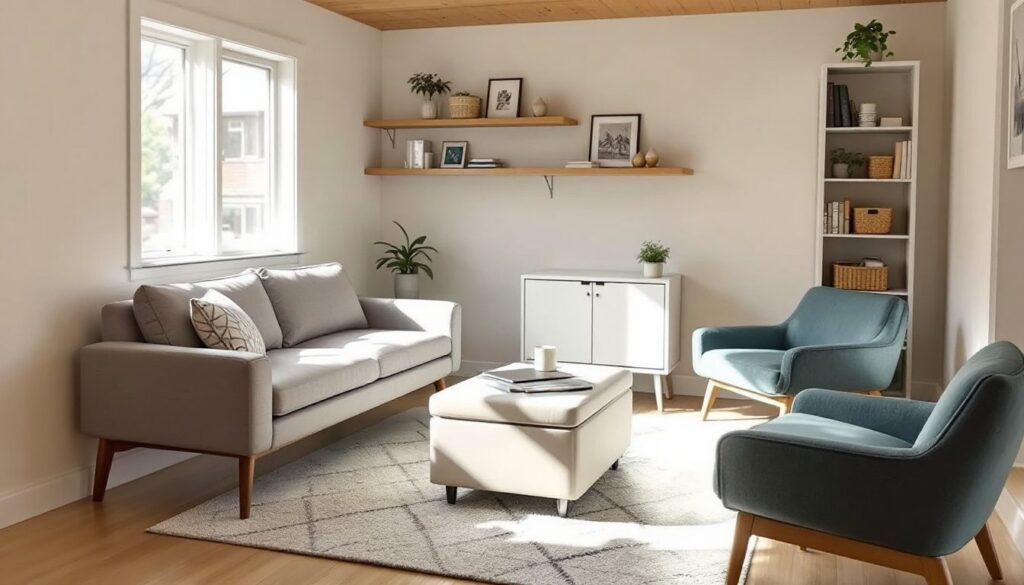
Apartment-sized sofas measure 60-72 inches wide and sit on exposed legs, which creates visual space underneath. Look for models with seat depths of 34-36 inches, deep enough to curl up but not so deep that shorter people can’t sit with their feet touching the ground. Avoid thick rolled arms that add width without function: track arms or English arms save 4-6 inches per side.
Loveseats work well when paired with alternative seating. A 58-inch loveseat plus two armchairs or poufs can seat four people while allowing flexible arrangement. This approach also lets you separate seating when needed for traffic flow.
Armless chairs and slipper chairs eliminate the space eaten by traditional arms. A pair of armless accent chairs can fit where a small sofa can’t. They’re also easier to move around for different configurations. Many small-space dwellers featured on Apartment Therapy favor this modular approach over fixed seating arrangements.
Floor cushions and poufs provide flexible, storable seating that works for casual gatherings. Large 24-inch square floor pillows with handles can stack in a corner or slide under furniture when not needed. They’re not suitable as primary seating for adults who have trouble getting up from the floor, but they excel as extra guest seating.
Built-in bench seating along walls maximizes space efficiency if you’re comfortable with basic carpentry. A bench with lift-up seats provides massive storage underneath while defining a seating zone. Add 3-4 inch foam cushions wrapped in durable fabric, and you’ve got comfortable, permanent seating that doesn’t encroach on floor space.
Storage Furniture That Maximizes Vertical Space
Tiny house living rooms can’t afford dead space. Vertical storage captures the often-wasted zone between furniture and ceiling, turning empty air into functional storage.
Tall, narrow bookcases make better use of space than short, wide ones. A bookcase that’s 72 inches tall and 24 inches wide holds more than a 36-inch tall, 48-inch wide unit while using less floor space. Anchor tall pieces to wall studs to prevent tipping, a requirement under most building codes for furniture over 30 inches tall in residential spaces.
Wall-mounted shelving completely eliminates floor footprint. Floating shelves above sofas or along empty walls provide display and storage without bulk. Use 1×8 or 1×10 lumber (actual dimensions 3/4″ x 7-1/4″ and 3/4″ x 9-1/4″) with heavy-duty brackets rated for the load. Space shelves 10-12 inches apart for books and decor.
Media consoles with vertical storage keep electronics organized while using height rather than width. Tower-style units that house a TV, gaming consoles, and media in a 24-inch wide footprint beat sprawling entertainment centers. Exploring various media console designs can reveal space-efficient options specifically suited to compact rooms.
Ladder shelves lean against walls and provide tiered storage with a slim profile. The angled design (12-18 inch depth at the base) takes up less room than traditional shelving while offering five or six levels of storage. They work especially well in corners, utilizing space that’s hard to furnish otherwise.
Storage cubes and modular systems adapt to changing needs. Cube organizers can be stacked vertically, arranged horizontally, or configured in L-shapes depending on available space. Using furniture risers can elevate these units, creating additional storage underneath for baskets or bins.
Choosing the Right Scale and Proportions
Getting scale right makes the difference between a living room that feels cozy and one that feels claustrophobic. Furniture proportions need to match the room, not your aspirations.
Measure religiously before buying anything. Know the exact dimensions of your space, including ceiling height, door width (will furniture fit through?), and any obstructions like radiators or built-in features. Create a floor plan on graph paper using 1/4-inch scale (1/4 inch equals 1 foot) and cut out paper templates of furniture you’re considering. Moving paper around is cheaper than returning a sofa.
Leave breathing room. A good rule is maintaining at least 18-24 inches of clearance for primary walkways and 12-18 inches for secondary paths. Any less and the space feels cramped: people will constantly bump into furniture.
Lower furniture profiles make ceilings feel higher. Sofas with 32-34 inch back heights (instead of standard 36-38 inches) and coffee tables at 14-16 inches tall (rather than 18-20 inches) keep sightlines open and make the room feel more spacious. This is the same principle that makes essential furniture pieces work effectively in various room sizes.
Leg height matters. Furniture that sits directly on the floor creates visual mass. Pieces with 4-6 inch exposed legs let light flow underneath, creating the illusion of more space. This is why mid-century modern furniture translates so well to tiny houses, those tapered legs do real work.
Arm width on seating often gets overlooked. Track arms (4-5 inches wide) versus rolled arms (8-10 inches wide) can mean the difference between squeezing in a side table or not. Multiply that by two arms, and you’re looking at saving nearly a foot of width.
Glass or acrylic furniture physically occupies space but doesn’t visually block it. A glass coffee table or acrylic side table maintains function while keeping the room feeling open. The effect is subtle but real.
Layout and Arrangement Tips for Small Living Rooms
Even perfect furniture won’t work if it’s poorly arranged. Tiny living rooms demand strategic placement that balances function, flow, and visual appeal.
Avoid pushing everything against walls. It’s counterintuitive, but floating furniture a few inches off walls can actually make a room feel larger by creating depth and shadow. It also improves traffic flow and prevents the “bowling alley” effect of clear perimeters with a dead center.
Define zones without walls. Use furniture arrangement to separate sitting areas from dining or work zones. An ottoman between a sofa and desk subtly divides functions without barriers. Area rugs also define zones, a 5×7 foot rug under seating furniture creates a visual boundary.
Angle furniture strategically. Placing a chair or sofa at a 45-degree angle in a corner can soften the space and create better conversation flow. This works especially well in square rooms that might otherwise feel boxy. Detailed ideas from renovation-focused sites like Young House Love often showcase angled arrangements in compact spaces.
Create a focal point. Every living room needs visual hierarchy. Whether it’s a window with a view, a fireplace, or a media center, arrange seating to relate to that focal point. This gives the room purpose and prevents random furniture scatter.
Use the “coffee table test.” There should be 14-18 inches between sofa and coffee table, close enough to set down a drink without stretching, far enough to allow passage. If you’re constantly climbing over the table, it’s too close or too large.
Consider traffic patterns. Walk through your normal daily movements. Do you trip over furniture legs? Constantly navigate tight squeezes? The 36-inch rule for major pathways isn’t optional, people need clearance to move comfortably.
Keep it flexible. In tiny houses, furniture often needs to move. Choose pieces with manageable weight and consider adding furniture sliders under heavy items. Being able to reconfigure your living room for different activities (movie night versus dinner party) multiplies its usefulness without adding square footage.
Conclusion
Furnishing a tiny house living room isn’t about making do with less, it’s about choosing better. Multi-functional pieces, proper scale, and smart arrangement transform tight quarters into genuinely livable space. Measure twice, buy once, and prioritize furniture that works as hard as you do. The result is a living room that feels spacious, functions efficiently, and proves that small doesn’t mean sacrificing comfort.