Shopping for dining room furniture means balancing style, durability, and investment value. Bernhardt has built a reputation over 130 years as a manufacturer that delivers on all three fronts. Their dining collections span traditional to contemporary aesthetics, with construction methods and materials that justify the price tag. Whether you’re furnishing a formal dining room or a casual eat-in space, understanding what sets Bernhardt apart, and how to select and maintain their pieces, helps you make a confident purchase decision.
Table of Contents
ToggleKey Takeaways
- Bernhardt dining room furniture uses solid hardwood construction, mortise-and-tenon joinery, and multi-step hand-rubbed finishes that justify its middle-to-upper-tier price range of $4,200–$9,900 for a complete set.
- Collections range from traditional styles like Vintage Patina and Marquesa to contemporary options like Linea and Profile, allowing homeowners to match existing décor without forcing a style mismatch.
- Calculate 24 inches of table perimeter per person for comfortable dining, and allow 36 inches of clearance on all sides of the table for chair pullout and traffic flow.
- Daily maintenance includes wiping spills immediately, using coasters and trivets, and avoiding direct sunlight; deeper care involves pH-neutral wood cleaner every 1–2 weeks and furniture wax every 3–6 months.
- Maintain home humidity between 35–55% year-round and check joint tightness annually to prevent wood shrinkage, swelling, and joint loosening that could compromise your Bernhardt investment.
- Upholstered Bernhardt chairs with performance fabrics resist staining and clean with water and mild soap, making them practical for families while still offering the comfort and durability expected from premium dining furniture.
What Makes Bernhardt Dining Room Furniture Stand Out
Bernhardt distinguishes itself through several manufacturing and design practices that elevate their furniture above mass-market competitors.
Solid hardwood construction forms the foundation of most Bernhardt dining tables and chairs. You’ll find North American hardwoods like oak, maple, and cherry, plus imported options like acacia and rubberwood. Tabletops often feature veneers over solid wood cores, not particle board, which allows for wider surfaces without warping while showcasing book-matched grain patterns.
Joinery methods matter. Bernhardt uses mortise-and-tenon joints on chair frames and table aprons rather than relying solely on screws or dowels. This traditional technique creates mechanical strength that holds up under decades of daily use. Chair seats often incorporate eight-way hand-tied springs in upholstered models, the same construction method found in high-end sofas.
Finish quality separates good furniture from great. Bernhardt applies multi-step hand-rubbed finishes that include stain, sealer, glaze layers, and topcoat. This process creates depth and protects the wood from moisture and UV damage. Distressing and antiquing effects, when present, are applied by hand rather than stamped.
Hardware and details receive equal attention. Metal ferrules, nailhead trim, and decorative hardware are installed by hand. Table extension mechanisms use steel ball-bearing glides rather than plastic tracks, ensuring smooth operation even after hundreds of extensions.
Design versatility stands out across their catalog. Unlike manufacturers that focus on a single aesthetic, Bernhardt produces everything from Chippendale-inspired formal sets to minimalist live-edge tables. This range lets homeowners find pieces that fit established décor rather than forcing a style mismatch.
Popular Bernhardt Dining Room Collections and Styles
Bernhardt organizes their dining furniture into distinct collections, each with coordinated tables, chairs, storage pieces, and often matching bedroom or living room options.
Traditional and Formal Collections
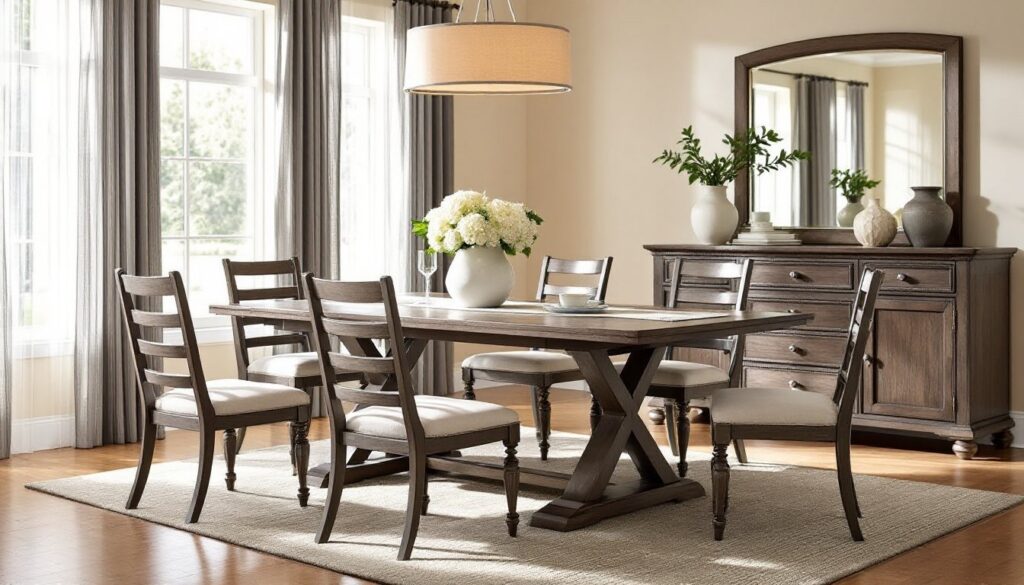
Vintage Patina remains one of their most recognized traditional lines. This collection features turned legs, parquet-pattern tabletops, and a weathered charcoal finish with gray undertones. The rectangular dining table extends from 84 inches to 120 inches with two 18-inch leaves, accommodating 8-10 people fully extended.
Chairs in this collection use ladder-back designs with upholstered seats in performance fabrics. The fabric choice matters for families, Bernhardt’s performance upholstery resists staining and cleans with water and mild soap.
Marquesa represents their formal high-end offering. Expect burled wood veneers, hand-carved details, and metallic silver-leaf accents. The collection includes a double pedestal table that extends to seat twelve, plus upholstered host chairs with nailhead trim. This collection suits formal dining rooms in homes with traditional or transitional architecture.
Modern and Contemporary Lines
Linea delivers clean-lined modern design with cerused gray oak finishes. The dining table features a thick rectangular top with chamfered edges and panel-style legs. Chairs pair chrome or brushed nickel metal frames with leather or fabric upholstery. This collection fits well in open-concept homes where the dining area flows into the kitchen and living spaces, an approach many contemporary interior designers favor for modern living.
Profile offers mid-century modern influences. Look for tapered legs, walnut veneers, and subtle curves. The Profile round dining table includes a self-storing butterfly leaf that tucks underneath the top when not in use, no separate storage needed.
Interlude bridges modern and traditional with mixed materials. Tables combine wood tops with metal bases in geometric patterns. Chairs might pair wood frames with metal accents and neutral upholstery. This versatility makes Interlude adaptable to various home styles.
Storage pieces across collections include china cabinets, buffets, and servers. Higher-end pieces feature soft-close drawer glides and adjustable shelving with plate grooves. If your home design follows trends seen in high-end residential interiors, Bernhardt’s contemporary collections offer the refinement expected in those spaces.
How to Choose the Right Bernhardt Dining Set for Your Space
Selecting dining furniture requires precise measurements and honest assessment of how you’ll actually use the space.
Start with room dimensions. Measure your dining area and subtract 6 feet from both length and width to determine maximum table size. This leaves 36 inches of clearance on all sides for chair pullout and traffic flow. In a 12′ × 14′ room, your table shouldn’t exceed 6′ × 8′.
Ceiling height affects visual proportion. Standard 8-foot ceilings pair well with conventional table heights (30 inches) and low-profile chairs. Rooms with 9-foot-plus ceilings can handle taller chair backs and substantial chandeliers without feeling cramped.
Consider table shape based on room layout:
- Rectangular tables maximize seating in rectangular rooms and work best for 6-10 people
- Round or oval tables encourage conversation and fit awkwardly shaped spaces but limit capacity to 6-8 people
- Square tables work in square rooms or as breakfast nooks (typically seat 4-8)
Extension mechanisms add flexibility. Butterfly leaves store within the table but limit extended length. Removable leaves require storage space but allow greater extension. Bernhardt’s self-storing leaves typically add 18-24 inches: separate leaves can add 36 inches or more.
Seating counts differ from manufacturer claims. Calculate 24 inches of table perimeter per person for comfortable dining. A 42″ × 84″ table technically seats eight (three per side, one per end) but six is more realistic for daily use.
Chair comfort matters for long meals. Test sit for at least five minutes. Check that:
- Seat height (typically 18-20 inches) lets your feet rest flat with thighs parallel to the floor
- Seat depth accommodates your leg length without hitting the back of your knees
- Back support hits your lumbar region
- Armrests (if present) slide under the table apron
Upholstery versus wood seats involves trade-offs. Upholstered chairs offer comfort for longer meals but cost more and require periodic reupholstering. Wood seats clean easily and suit homes with young children or messy eaters, though cushions can be added later.
Match finish tones to existing woodwork and furniture. Bernhardt offers multiple finishes within collections. Bring wood samples or photos of your flooring and trim when shopping. Don’t try to exactly match wood species, mixing woods works if you coordinate undertones (warm with warm, cool with cool).
Budget for the full set. Bernhardt tables often run $1,800-$4,500 depending on size and collection. Chairs cost $400-$900 each. A table with six chairs typically totals $4,200-$9,900. Factor in delivery fees ($200-$500 for white-glove service) and potential costs for professional assembly if needed.
Caring for and Maintaining Your Bernhardt Dining Furniture
Proper maintenance protects your investment and keeps furniture looking new for decades.
Daily care requires minimal effort:
- Wipe spills immediately with a soft, damp cloth, don’t let liquids sit
- Use coasters under all glasses and mugs: condensation damages finishes
- Place trivets or hot pads under serving dishes (heat causes white rings and finish damage)
- Avoid placing furniture in direct sunlight, which fades finishes and can cause splitting
Weekly cleaning involves dusting with a microfiber cloth in the direction of the wood grain. Avoid feather dusters, they scratch finishes.
For deeper cleaning, use a pH-neutral wood cleaner (not all-purpose sprays, which contain ammonia or silicone). Apply cleaner to the cloth, never directly to the furniture. Products like Murphy’s Oil Soap diluted per instructions work well.
Polishing frequency depends on use. Apply a quality furniture paste wax or polish every 3-6 months. Wax provides protection and enhances the finish depth. Apply thin coats with a soft cloth, let dry to a haze, then buff. Avoid silicone-based polishes, they create buildup that’s difficult to remove and can interfere with future refinishing.
Table pads make sense for daily use in homes with children or for protecting high-end pieces. Custom-fit pads (available from companies like Pioneer and Berger) cost $200-$400 but prevent most damage. Store pads flat, rolled storage causes warping.
Extension leaf storage requires attention. Leaves expand and contract differently than the main table when stored separately. Keep leaves in the same room where the table lives, in a climate-controlled environment. Wrap in furniture blankets or soft cloth, never plastic, which traps moisture.
Damage repair often requires professional help:
- Minor scratches can be concealed with touch-up markers matched to the finish color
- Water rings and white marks sometimes respond to gentle rubbing with 0000 steel wool and mineral oil, working in the grain direction
- Deep gouges, burns, or finish damage need professional furniture repair
Upholstered chairs need vacuuming with an upholstery attachment monthly. Bernhardt’s performance fabrics clean with water and mild dish soap: test in an inconspicuous area first. Blot stains, don’t rub. For leather upholstery, use leather-specific cleaners and conditioners every 3-6 months.
Environmental factors affect longevity. Maintain home humidity between 35-55% year-round. Low humidity causes wood to shrink and joints to loosen: high humidity causes swelling and mold. Use humidifiers in winter and dehumidifiers in summer if needed.
Check joint tightness annually. Loose screws can be tightened: loose mortise-and-tenon joints may need glue reapplication by a professional. Addressing minor issues prevents major repairs.
Conclusion
Bernhardt dining room furniture represents a middle-to-upper-tier investment that delivers quality construction, design versatility, and longevity when properly maintained. Their range accommodates various aesthetics and room sizes, from compact dining spaces to formal entertaining areas. Careful selection based on accurate measurements and realistic use patterns, combined with consistent maintenance practices, ensures these pieces serve your home for decades.