Most homeowners spend weeks choosing the perfect sofa, then shove it against a wall and call it done. But placement matters as much as the piece itself. A well-arranged living room improves traffic flow, encourages conversation, and makes every square foot work harder, whether you’re dealing with a sprawling family room or a cramped apartment. This isn’t about following rigid design rules or chasing trends. It’s about understanding how furniture arrangement affects function, then applying proven layout strategies that fit your space and lifestyle.
Table of Contents
ToggleKey Takeaways
- Measure your space accurately and identify structural elements like doors, windows, and electrical outlets before arranging any living room furniture, as poor placement can create bottlenecks and safety hazards.
- Establish a clear focal point—whether a fireplace, TV, or architectural feature—and orient your seating to face it, with the sofa positioned 6 to 8 feet away for optimal sightlines and comfort.
- Design conversation areas by spacing seating 4 to 10 feet apart with a coffee table as the anchor, leaving 14 to 18 inches of clearance for comfortable movement and accessibility.
- Use the golden triangle seating rule—positioning your sofa as the base with two complementary chairs at the other points—to create visual balance and encourage interaction without a rigid “bus stop” lineup effect.
- Maintain primary walkways at 36 inches minimum (42–48 inches for high-traffic routes) and secondary walkways at 24–30 inches to ensure safe, functional traffic flow through your living room daily.
- In small spaces, choose scaled-down furniture, float pieces away from walls to create depth, and prioritize multi-functional items that maximize utility without cluttering the room.
Why Furniture Arrangement Matters More Than You Think
Furniture arrangement dictates how a room functions. Poor layout creates bottlenecks, makes spaces feel smaller, and turns seating areas into awkward islands where nobody wants to sit. Good arrangement does the opposite, it opens up walkways, defines zones for different activities, and creates natural gathering spots.
Consider the structural elements first. Load-bearing walls, windows, doors, and built-ins aren’t negotiable. Your furniture needs to work around them, not against them. A sectional blocking the only pathway to the kitchen forces people to squeeze past or walk around, annoying in daily use, dangerous during an emergency egress.
Measure everything before moving a single piece. Use actual dimensions, not estimates. A standard sofa runs 84 to 96 inches long, but measure yours. Note the swing radius of doors (typically 30 to 36 inches clear width for interior doors per IRC). Mark electrical outlets and cable jacks on your floor plan, you’ll need them for lamps and electronics, and extension cords running across walkways are trip hazards.
Scale matters. Oversized furniture in a small room makes everything feel cramped. Undersized pieces in a large space look lost and create awkward gaps. Aim for proportional balance, your largest piece (usually the sofa) should anchor the room without dominating it.
Start With Your Living Room’s Focal Point
Every functional living room has a focal point, the feature your eye lands on when you walk in. It might be a fireplace, a large window with a view, built-in shelving, or your TV. Identify it, then arrange seating to face it or angle toward it.
Fireplace focal points: Position your sofa perpendicular or parallel to the hearth, 6 to 8 feet away for optimal heat and sightlines. Flank with chairs or a loveseat to create a U-shape. Don’t block the firebox, if you need to run a TV above the mantel, mount it high enough to clear artwork or decor, but not so high you’re craning your neck (eye level when seated is ideal, around 42 inches from the floor to the center of the screen).
TV as focal point: Many layouts revolve around screens now. Mount the TV or place it on a console, then position seating within a comfortable viewing distance, typically 1.5 to 2.5 times the screen’s diagonal measurement. For a 65-inch TV, that’s 8 to 13 feet. Avoid placing seating directly under windows that cause glare during daytime viewing.
Window or architectural features: If your focal point is a bay window, French doors, or a striking accent wall, orient seating to showcase it. Arrange chairs or a sofa to frame the view, pulling pieces away from walls to create depth. This approach works well in homes where TVs aren’t the priority or can be tucked into a less prominent spot.
No obvious focal point? Create one. A gallery wall, a large piece of art, or a statement shelving unit can anchor your furniture arrangement and give the room purpose.
Create Conversation Areas That Actually Work
A conversation area is a seating arrangement that encourages eye contact and interaction without forcing people to shout across the room or twist awkwardly to see each other. The key is proximity and orientation.
Distance matters. Place seating pieces 4 to 10 feet apart, close enough for normal conversation volume, far enough to avoid crowding. Closer than 4 feet feels intrusive. Beyond 10 feet, you’re yelling or straining to hear.
Anchor with a coffee table or ottoman in the center. It provides a surface for drinks and remotes, defines the seating zone, and keeps the arrangement cohesive. Leave 14 to 18 inches of clearance between the table edge and seating, enough to slide past without bumping knees, but close enough to reach a glass without lunging.
For larger rooms, consider multiple conversation zones. A primary seating group near the fireplace or TV, plus a secondary zone with two chairs and a side table near a window. This breaks up a long room and accommodates different activities, one group watching a movie, another reading or chatting.
The Golden Triangle Rule for Seating
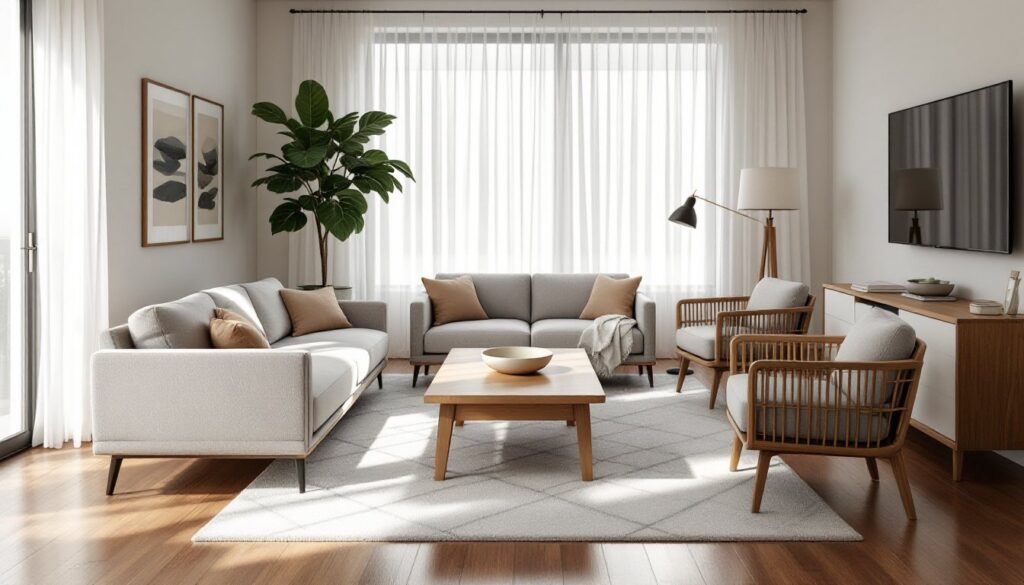
The golden triangle concept places three seating pieces (sofa, two chairs, loveseat plus chair, etc.) to form a rough triangle. It’s a design principle borrowed from kitchen layout, adapted for living rooms. The idea: create visual balance and help conversation from multiple angles.
Position your largest piece as the triangle’s base, typically the sofa. Place two complementary pieces (chairs or a loveseat) at the other points, angled slightly inward. This setup feels inviting and avoids the “lineup” effect where everyone stares straight ahead like they’re at a bus stop.
The triangle doesn’t need to be equilateral. Adjust proportions based on room shape and focal point location. In a narrow room, you might create a longer, flatter triangle. In a square room, aim for more balanced spacing.
Don’t forget side tables. Every seat should be within arm’s reach of a surface for drinks, 18 to 24 inches away is ideal. End tables flanking a sofa, a console behind it, or clustered side tables between chairs all work.
Navigating Common Living Room Layout Challenges
Not all living rooms are blank-canvas rectangles. Most have quirks, awkward angles, too many doors, insufficient wall space, or odd proportions. Here’s how to handle the common ones.
Open floor plans: Without walls to define zones, furniture does the job. Use the back of a sofa as a room divider, separating the living area from a dining zone or entryway. Add a console table behind the sofa for extra surface space and visual weight. Area rugs anchor each zone, make sure they’re large enough to fit all front legs of seating pieces (8×10 feet minimum for most living areas).
Too many doorways: Three or four doors in one room fragment wall space and complicate arrangements. Float furniture away from walls, anchor a sofa in the center of the room facing the focal point, with a console or bookcase behind it. This opens up walkways along the perimeter and makes the layout feel intentional rather than haphazard. Understanding the basics of furniture placement helps when dealing with challenging floor plans.
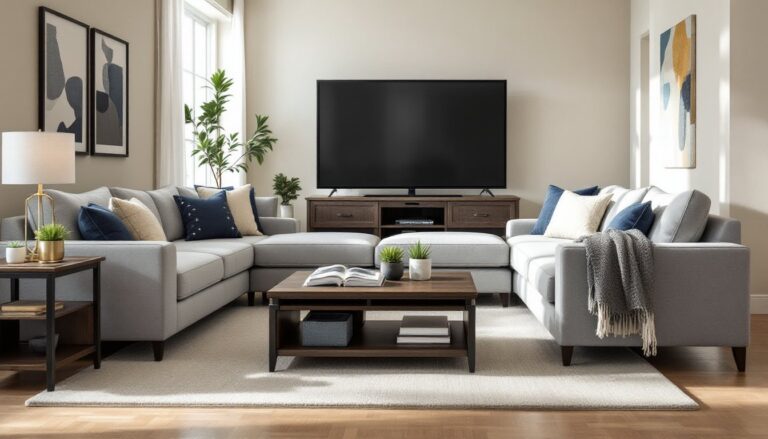
Corner fireplaces: Tough to arrange around, but manageable. Angle your sofa toward the fireplace corner, then place chairs on either side to complete the seating zone. A sectional can wrap the corner, placing the TV on the adjacent wall.
Long, narrow rooms: Avoid pushing everything against the long walls, it creates a bowling alley effect. Instead, break the space into two zones: seating at one end, a desk or reading nook at the other. Place the sofa perpendicular to the long walls to visually widen the room.
Arranging Furniture in Small or Narrow Spaces
Small living rooms require ruthless editing. Every piece needs to earn its place. Start by measuring your available floor space, then choose scaled-down furniture, apartment-sized sofas (76 to 84 inches), armless chairs, and slim-profile tables.
Use vertical space. Tall bookcases and wall-mounted shelves draw the eye up and free up floor area. If you’re mounting a TV, choose a low-profile bracket and tuck cable boxes on the wall behind it or in a nearby cabinet.
Multi-function pieces work overtime. Ottomans with storage, nesting tables, and sofa beds maximize utility without cluttering the room. Experts who focus on small-space design often recommend furniture that can be easily moved or reconfigured.
Float smaller pieces. In a narrow space, pulling a loveseat a few feet off the wall creates a walkway behind it and makes the room feel less cramped. Pair it with a couple of lightweight accent chairs that can be repositioned as needed.
Mirrors and light colors help, but that’s cosmetic. The real fix is furniture placement. Keep the center of the room open, align pieces parallel to walls when possible, and resist the urge to cram in extra seating nobody will use.
Traffic Flow and Walkway Essentials
Traffic flow is the invisible network of paths people take through your living room, from the entryway to the kitchen, past the sofa to the hallway, around the coffee table to a chair. Ignore it, and your layout fails no matter how stylish it looks.
Primary walkways (main routes through the room) need 36 inches minimum of clear width. That’s enough for one person to pass comfortably, or two to squeeze by without turning sideways. High-traffic paths, like the route from the front door to the main living area, should ideally have 42 to 48 inches.
Secondary walkways (paths around furniture within a seating area) can be narrower, 24 to 30 inches, but never less than 24. That’s the minimum clearance to sidestep a coffee table or walk between a chair and a wall.
Test your layout by walking it. Literally. Move through the room as you would in daily use, carrying a laundry basket, holding a drink, guiding a kid to the bathroom. If you’re bumping furniture or taking detours, adjust.
Pay attention to door swings. An interior door typically needs 30 to 32 inches of clearance (per IRC residential code), and the arc shouldn’t hit furniture. If a door swings into the room and smacks a chair, either move the chair or consider a different door type (pocket door, barn door, or reversed swing, if framing allows, this may require a permit in some jurisdictions).
Electrical access affects traffic flow, too. If the only outlet for a floor lamp is across the room, you’ll run a cord that becomes a trip hazard. Plan furniture placement with outlets in mind. If you’re in the middle of a remodel and can add outlets, install them 12 to 18 inches above the floor on walls where you’ll place media furniture or end tables (check NEC Article 210.52 for residential outlet spacing requirements, at least one outlet every 12 feet along wall space).
Finally, consider emergency egress. The International Residential Code (IRC) requires habitable rooms to have at least one operable window or door for emergency escape. Don’t block windows with heavy furniture that can’t be moved quickly. If a window is your primary egress route, keep the path clear.
Furniture arrangement isn’t about chasing a specific aesthetic, it’s about making your living room work for how you actually use it. Measure carefully, respect traffic flow, build conversation zones, and adapt proven layout principles to fit your space. The result is a room that looks better because it functions better.