When shopping for a dining room table, the choices can feel overwhelming. Ashley Furniture has built its reputation on offering a broad range of dining tables that balance quality construction, style variety, and accessible pricing. Whether outfitting a compact eat-in kitchen or a formal dining space, understanding what Ashley brings to the table, literally, helps homeowners make informed decisions. This guide walks through Ashley’s dining table lineup, breaks down sizing, material choices, and pairing strategies to ensure the centerpiece of any dining room checks all the boxes.
Table of Contents
ToggleKey Takeaways
- Ashley Furniture dining room tables range from $400 to $1,800 and feature quality manufacturing, extensive warranty coverage, and quick availability for homeowners on tight timelines.
- Farmhouse and modern designs dominate Ashley’s collection; farmhouse tables with distressed finishes hide wear better for heavy-use families, while contemporary glass or metal models suit minimalist spaces but require more maintenance.
- Proper sizing requires 24 inches of table edge per person and 36 inches of clearance for chair pull-out; a 72-inch table seats six comfortably and many Ashley models offer drop-in extension leaves for flexibility.
- Engineered wood with veneer is durable and resists warping, while solid wood tables can be refinished multiple times but require careful attention to humidity-related expansion and contraction.
- Pairing Ashley dining room tables with the right chairs, rugs, and lighting—ensuring matching heights, extending rugs 24 inches beyond table edges, and hanging fixtures 30-36 inches above the surface—creates functional, cohesive dining spaces.
- Test chairs with your table before purchasing to confirm arm heights clear the table apron and allow comfortable seating without gaps or awkward angles.
Why Ashley Furniture Stands Out for Dining Room Tables
Ashley Furniture has become one of the largest furniture manufacturers in North America, and their dining table collection reflects decades of refining production methods and design pipelines. The company operates its own manufacturing facilities, which allows tighter quality control compared to brands that outsource production entirely.
One major advantage is warranty coverage. Most Ashley dining tables come with a one-year manufacturer’s warranty covering defects in materials and workmanship. While that’s industry standard for furniture at this price point, Ashley’s extensive retail and service network makes claims and replacements more straightforward than dealing with smaller or online-only brands.
Price range is another factor. Ashley dining tables typically run from $400 to $1,800, positioning them in the mid-market sweet spot. That pricing reflects engineered wood construction (veneers over particleboard or MDF cores) on many models, with solid wood options available at the higher end. For homeowners balancing budget with longevity, this range offers tables that can handle daily use without requiring a second mortgage.
Ashley also maintains a large inventory of in-stock items. Unlike custom furniture makers with 12-week lead times, most Ashley tables ship within days or are available for immediate pickup at retail locations. For anyone working on a timeline, new home closings, post-move furnishing, or replacing a damaged table, that availability matters.
Popular Ashley Dining Table Styles for Every Home
Ashley’s catalog spans multiple design aesthetics, making it easy to find a table that matches existing decor or sets the tone for a dining room refresh.
Farmhouse and Rustic Tables
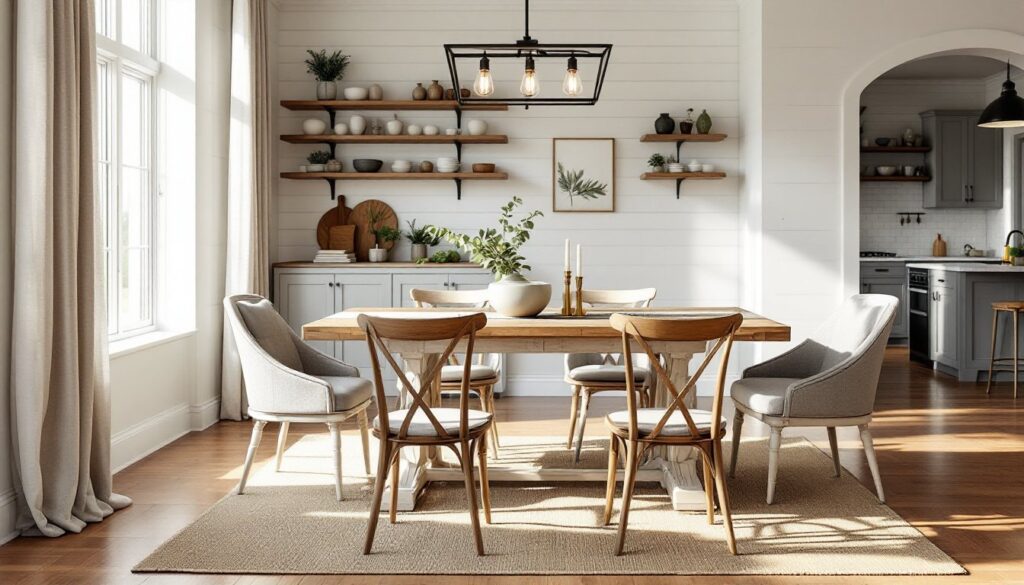
Farmhouse tables remain one of Ashley’s bestselling categories. These tables typically feature planked tops with visible wood grain, chunky turned legs, and distressed finishes in whitewash, gray, or natural wood tones. The Bolanburg collection, for example, uses an antique white finish with a weathered oak top, a look that pairs well with shiplap walls, open shelving, and pendant lighting.
Construction on farmhouse tables often includes solid pine legs with engineered wood tops, which keeps weight and cost manageable while delivering the visual heft of reclaimed barn wood. Widths typically run 36 to 42 inches, accommodating casual dining without overwhelming smaller rooms. For homeowners drawn to furniture galleries showcasing cottage or country styles, these tables fit right in.
One practical note: distressed finishes hide scratches and dings better than smooth, glossy surfaces. If the table will see heavy use from kids, crafts, or assignments, that’s a functional benefit beyond aesthetics.
Modern and Contemporary Designs
On the opposite end of the spectrum, Ashley’s modern collections favor clean lines, geometric bases, and minimalist profiles. Tables like the Kavara counter-height dining set use metal frames with medium-brown wood tops, creating an industrial-modern hybrid popular in urban lofts and open-concept homes.
Contemporary tables often incorporate glass or faux marble tops. Tempered glass tables, such as those in the Napoli collection, work well in smaller spaces because the transparent surface doesn’t visually fragment the room. But, glass requires more maintenance: fingerprints and water spots show immediately, and using trivets or placemats becomes non-negotiable to avoid heat damage.
Counter-height tables (36 inches tall versus the standard 30 inches) fall into this category and appeal to homeowners who prefer a casual, bar-style dining experience. They pair with stools rather than traditional chairs, which can free up visual space in combined kitchen-dining areas. Just confirm ceiling height and pendant light clearance before committing, standard lighting positioned for 30-inch tables will hang too low over counter-height models.
How to Choose the Right Size Ashley Dining Table
Sizing a dining table correctly prevents both cramped seating and wasted space. The baseline formula: allow 24 inches of table edge per person for elbow room, and maintain 36 inches of clearance between the table edge and walls or furniture for chair pull-out.
For a table seating six people comfortably, that translates to a minimum 72-inch length (six seats × 12 inches per half-seat). Ashley’s rectangular tables typically come in 60-inch, 72-inch, and 84-inch lengths, with many offering drop-in extension leaves that add 12 to 18 inches. Extension mechanisms vary, some use butterfly leaves stored under the table, others require separate leaf storage. Test the extension in-store if possible: poorly designed mechanisms bind or sag under the weight of dishes.
Room size drives table proportions. For a dining room measuring 10 × 12 feet (120 × 144 inches), subtracting the 36-inch clearance on all sides leaves a 48 × 72-inch footprint for the table. That’s comfortable for a 42 × 66-inch table, with room to extend for larger gatherings.
Round and square tables suit smaller spaces or promote conversation. A 48-inch round table seats four to six, depending on chair style, and the lack of corners improves traffic flow in tight layouts. Ashley’s round pedestal tables (single central base) offer more legroom than four-legged designs, though pedestal bases can tip if leaned on heavily, an issue with households that have young kids.
One often-overlooked dimension: table height. Standard dining tables measure 30 inches tall, which pairs with chairs that have 18-inch seat heights. Counter-height tables (36 inches) require 24-inch stools. Mixing heights creates ergonomic headaches, so when looking at furniture essentials for a dining space, confirm chair and table heights match before purchasing.
Material and Finish Options: What Works Best for Your Space
Material choice affects durability, maintenance, and long-term appearance. Ashley uses several common materials across their dining table lines, each with trade-offs.
Engineered wood with veneer dominates the mid-price range. This construction bonds a thin layer of real wood (oak, pine, or acacia) over a particleboard or MDF core. Veneered tables resist warping better than solid wood because the core remains dimensionally stable with humidity changes. But, veneer can chip or peel at edges if struck hard, and deep scratches expose the core material underneath. For families with young children, corner guards and placemats become necessary.
Solid wood tables, typically oak, pine, or acacia, appear in Ashley’s higher-end collections. Solid wood can be sanded and refinished multiple times, extending lifespan significantly. Weight is the downside: a solid oak table can exceed 150 pounds, making moves or rearrangements a two-person job. Solid wood also expands and contracts with seasonal humidity swings, which means gaps can appear in tabletops during winter heating or summer AC cycles. That’s normal and not a defect.
Metal bases pair with both wood and glass tops in industrial and modern styles. Powder-coated steel resists rust and scratches better than bare metal, but inspect welds and joints for quality. Lightweight metal bases can wobble on uneven floors, adjustable leveling feet solve this, but not all models include them. Many modern design resources highlight metal-frame tables for their sleek profiles.
Finish options range from natural wood stains to painted surfaces. Two-tone finishes, white or gray bases with natural wood tops, remain popular in transitional styles. High-gloss finishes show every fingerprint and water ring: matte or satin finishes prove more forgiving in daily use. If the table will sit near windows, UV exposure can fade stained wood over time. Rotating table runners or using UV-filtering window film mitigates this.
For homeowners exploring different eras of design, some 1920s furniture styles featured dark lacquered finishes, though modern reproductions often use polyurethane for easier maintenance.
Matching Your Ashley Dining Table with Chairs and Decor
Pairing chairs with a dining table involves more than matching wood tones. Seat height, style cohesion, and practical use all factor in.
Matching sets versus mix-and-match: Ashley sells complete dining sets (table plus four to eight chairs), which simplifies coordination but limits flexibility. Buying the table separately allows mixing chair styles, upholstered seats at the heads, benches along sides, or metal stools for an eclectic look. This approach requires careful attention to scale: oversized chairs crowd a narrow table, while delicate chairs look lost around a chunky farmhouse slab.
Upholstered versus hard seating affects comfort and maintenance. Fabric chairs with cushioned seats invite longer meals but stain easily. Performance fabrics (polyester blends treated for stain resistance) or faux leather offer middle ground. Hard wood or metal chairs wipe clean instantly but become uncomfortable after 20 minutes. For daily-use tables, at least two upholstered chairs at the table ends improve comfort for longer dinners without requiring eight chairs to maintain.
Bench seating along one table side maximizes seating capacity in tight spaces and tucks fully under the table when not in use. A 60-inch table with a bench on one side and chairs on the other can seat six adults comfortably versus five with all chairs. But, benches require sliding in and out, less convenient for older adults or anyone with mobility issues.
Decor integration ties the table into the broader room design. A rustic farmhouse table grounds a room, allowing lighter, airier decor elsewhere. Modern glass tables suit minimalist spaces with contemporary furniture and monochromatic palettes. Rug placement matters: a dining rug should extend at least 24 inches beyond all table edges so chair legs remain on the rug when pulled out. Natural fiber rugs (jute, sisal) suit casual farmhouse tables but are difficult to clean: low-pile synthetic rugs handle spills better under modern tables.
Lighting also plays a role. Pendant lights or chandeliers should hang 30 to 36 inches above the tabletop and be roughly half to two-thirds the table width. A 60-inch table pairs well with a 24- to 36-inch fixture. For extended tables, linear fixtures or multiple pendants prevent dark spots at the ends.
Finally, consider the table’s relationship to other furniture pieces in adjacent spaces. Open-concept homes benefit from repeating finishes or materials, a gray-washed dining table can echo gray cabinetry in the kitchen, or metal table legs can match metal bar stools at the island. Those visual connections create cohesion without requiring identical furniture throughout.
For those exploring regional styles, Ashley Furniture Santa Fe collections offer Southwestern-inspired designs with warm wood tones and wrought-iron accents that pair naturally with terracotta tiles and woven textiles. Understanding how individual pieces interact with the larger space prevents isolated “showroom” looks where the table feels disconnected from the room it occupies.
One last practical tip: test chairs with the table before buying if possible. Sit down, scoot in, and confirm arm height clears the table apron (the vertical frame under the tabletop). Chairs with tall arms won’t tuck under some tables, leaving gaps or requiring awkward angling. Taking five minutes for that fit check prevents frustration and return trips.